
We were in Guangzhou, China this January, the place that I have spend most of my time before 17 years old. I told Kevin that the place where I live is a place that gives me immense peace and happiness. I also wanted to share this peace with him.
There was one afternoon I went to meet one Chinese colleague of mine. After our afternoon meeting and dinner later that night, we went to Fangsuo(方所). Fangsuo is one of my favorite bookstores.
We left Tiyu Center Station and took Line 1 of Metro to Tiyu Xilu Station. Then we transferred there to Line 3 to go to Shipaiqiao. At Tiyu Xilu, Line 3 has three directions. It was around five in the afternoon, and the metro staff were preparing for the evening rush hour. We hurried quickly through the crowd. Strangely enough, I noticed that when I am in the Guangzhou metro, I just walk very fast. Much faster than I would walk in the US. Perhaps it’s because the granite floors are so smooth—walking fast doesn’t feel tiring.
I used to clearly remember how to get to Shipaiqiao, which of the three exits to take. But I hadn’t taken the Guangzhou metro in too long. I could only pull Kevin along and follow my intuition to find a path, like taking a deep breath and sinking underwater.
I guessed right.
We took one stop from Tiyu Xilu to Shipaiqiao. I remember it was Exit D.
From a distance, Fangsuo looks like a cave built out of stacked books.
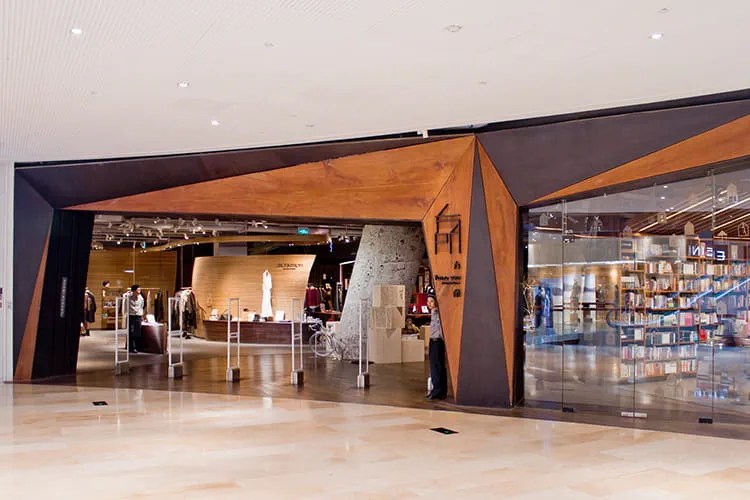
I wasn’t a particularly outgoing child. When I was young, I liked to define myself as a book-loving child. When visiting other people’s homes, I would find a book on their bookshelf and flip through it from beginning to end. Not very polite. At best I would greet everyone briefly. During meals I would keep the book nearby and quietly place it on the back of my chair. If the adults’ conversation became boring, I would secretly pull the book out from behind and read it on my lap.
Reading books was a religion for me.
One major goal of reading was to make me appear smarter. Another goal was to avoid interpersonal relationships. Adults wouldn’t ask me how my grades were or what I liked. Reading was a very convenient hobby. Oh, the child likes reading? Good, then we won’t bother talking to her. It was even more true with other children—interactions lead to harm. Conversations about who gave whom a pretty notebook today, whose math is better, yours or mine, worries about this or that. I wanted to stay away from all of it. I read books. I was smarter than everyone else.
But Fangsuo always made me feel not very smart. There are so many kinds of books there that I cannot claim to understand any field. I feel discouraged. Yet I still come often; somehow it makes my persona feel a little more fitting.
In high school I liked reading García Márquez and Borges. That seemed to light up a small unexplored corner of Fangsuo: after entering, on the right-hand side, around the fourth or fifth bookshelf, in the middle section, there were shelves full of García Márquez’s books. After that I left here—to go the US, to university, to work. By the time I started my second full-time job, my boss was Colombian. For a long time, I felt that she looked like Rebeca from One Hundred Years of Solitude. Once, during a road trip to West Virginia, I hit a deer and my car was completely wrecked. The owner of the repair shop was Argentine. Many years ago, Borges had been his neighbor.
And now I am here again, facing the bookshelves. These stories, these faces, jump vividly through my mind. I pull out a book. Behind it are more books, and behind them a silent bookshelf. I imagine that on the other side of the shelf is the version of me from more than ten years ago buying books here. Through the shelves, I seem to see myself—the attempt of a young girl trying to become complicated.
Then other things begin to sprout. The week before coming to Fangsuo I was writing the last chapter of my book, which mentions colleagues of mine from Ecuador and Venezuela. So I knelt in front of the shelf looking for books by writers from Ecuador and Venezuela.
I left here for a long time. When I came back, my heart carried many more questions about the world. I tried to let the future version of me see the present version of me through the bookshelf.
I pointed to the end of the shelves and told Kevin that if I ever held a book signing here in the future, I would sit at the end of those shelves.
As if, vaguely, I could see myself again.
When I walked to the end of the shelves, I saw a literary magazine I had recently contributed to. I opened to the page with my photo printed on it.
During all those years away from Fangsuo, all those years away from Guangzhou, I had never walked to the end of the shelves. I left here with the arrogance and timidity unique to young adult, and I returned with stories that existed beyond books.
In the photograph, I am kneeling in the snow in Alaska.
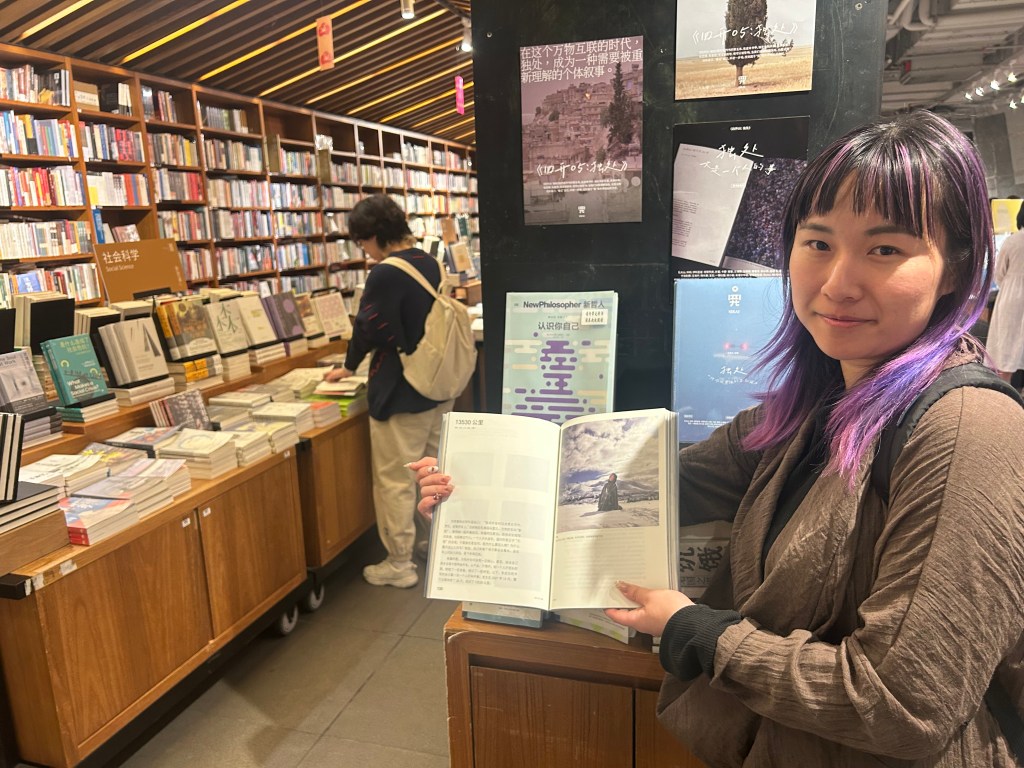
Looking back along the path I came from, I seem to see my childhood self again, pretending to be sophisticated while flipping through books she could not understand.
Kevin wandered around, preparing to buy an English book. He walked many circles in the souvenir and stationery section that I loved most as a child. He showed me his favorite teacup.
Afterward we walked to the children’s book section. Kevin is currently trying hard to learn Chinese. I thought it might be good to buy him some Chinese children’s books so he could learn characters.
We have been married for about half a year. We spend a lot of time discussing the names of our future children. There isn’t any specific timeline yet, but the act of choosing names makes Kevin extremely happy. Choosing a Chinese name is not like choosing an English name. English names mostly already exist—David, Joseph, Lindsey, Sarah. Chinese characters can be freely combined and made into names. Kevin likes to filping through his dictionary, putting together characters he likes or finds interesting.
For many years, I have only had one name in mind.
Beiming (北冥).
Beiming, as in “In the Northern Darkness there is a giant fish.” It cames from Enjoyment in Untroubled Ease (逍遥游) by Zhuangzi (庄子), a famous Chinese philosopher。
We saw a children’s book called There Is a Fish in Beiming. It was a more kid friendly adapation of Enjoyment in Untroubled Ease. So we brought it home. Every night before bed Kevin reads one page. He recognizes about seventy percent of the characters. But most of the time I read with him and teach him the characters.
“Long ago…”
“Before.”
“In a place called Bei—”
“Beiming.”
“In that place, there lived… a very, very big…”
“A very, very big fish lived there.”
In this bookstore,
is the story of my entire life hidden here?
I begin to think so.


Leave a Reply