
I woke up very early. I’d gone to sleep at midnight the night before. There were several dreams through the night — I dreamed of strangers breaking into my room.
The guesthouse I stayed in last night was the quintessential seaside small-town style: a ship’s wheel hung on my door. The bathroom curtain was printed with lighthouses and the dramatic cliffs typical of Acadia. The towels were blue-and-white striped; looking more closely, they were a little worn, but you could tell the host had laundered them with genuine care and love. The room was filled with a layering of things: the maritime culture of Maine, a veteran’s honorable discharge certificate the host had found at a thrift store, the Virgin Mary, and a Buddha statue.
That morning I found myself with an unexpected abundance of time. I did yoga, and chatted with the host for a while.
The host is a Filipino-American woman who grew up in the Bay Area. Her mother is one-quarter Chinese. She pointed to a oil painting of her mother on the wall. Her mother was beautiful — that mixed look that Filipino people sometimes have, with a touch of something Frida-like about her. Her mother had twelve children, and her father had died young. Her mother had to shoulder the weight of the whole family alone. She once ran a beauty salon.
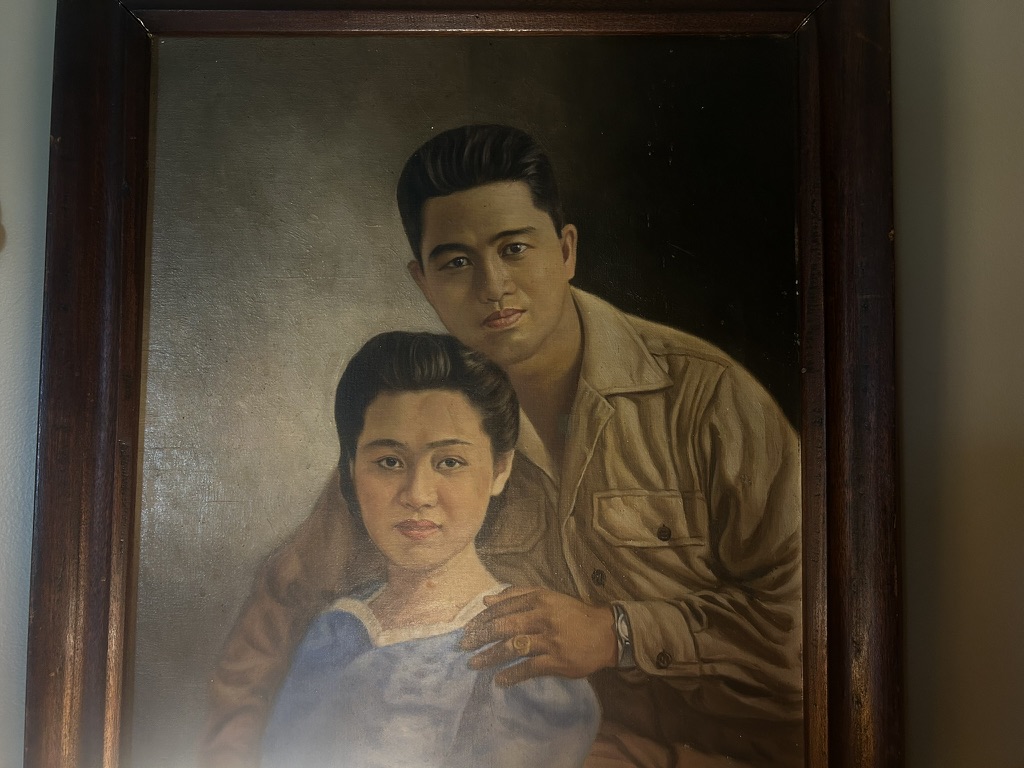
The host spent her whole life in the Bay Area, then spent some time in Idaho. At sixty, she decided she wanted to see another part of America — a Bay Area girl, just like that, moved to Maine, a place of tremendous snow.
When she first arrived, she didn’t know how to shovel snow. A seventy-one-year-old neighbor lady taught her how to wrap herself against it. She asked her neighbor: what if the snow bank gets really, really thick?
The neighbor said: then you’ll need to wake up every two hours through the night and shovel it away, little by little.
She told me that a few years ago she finally earned her bachelor’s degree. Her friends had all tried to talk her out of it at the start. That year, she was sixty.
Beside the door, the Buddha statue sat in front of a wooden plaque inscribed with Chinese characters: love, peace, serenity.
She had been a massage therapist in her earlier years. Through studying massage, she had also absorbed a great deal of Chinese culture. She herself is Catholic. In Bangor, she also attends a Protestant church. A friend from the congregation once asked her why she kept a Buddha statue in her home. She turned the question back: could someone who teaches us about love and peace really be a demon?
She laughed with an open, bright ease.
She said she had never imagined how hard it would be to move north. People up here are so capable and self-sufficient — there is simply no one to call for repairs around the house, large or small. So she learned to do them herself. Work is scarce in the north, and no one here cares whether or not she has a bachelor’s degree.
She has never earned more than fifty thousand dollars in a single year. She’s carrying some debt now. She said she never imagined she would ever be in debt. She now works the front desk at a hotel in Bangor, and between that and the income from the guesthouse, she can just barely break even.
The kettle on the stove let out a sharp, piercing whistle.
“You feel ashamed of it,” I said.
“Yes,” she said. “I feel very ashamed that I’m in debt.”
“There’s no need to feel ashamed,” I told her.
I poured the boiled water into my thermos, left the guesthouse, and left Bangor.
It suddenly occurred to me:
We don’t have to feel ashamed of anything.
In her home, I felt something she herself had not noticed — a kind of abundance.


Leave a Reply