
01
A few days ago, on the ferry from Prince Edward Island to Nova Scotia, I met a father and son. It wasn’t a long crossing — about an hour and a half. After sitting inside the cabin for a while, I decided to go up to the deck for some fresh air. I was wearing a Tufts sweatshirt. Tufts is where I went to graduate school, and where Kevin did his undergraduate degree. The sweatshirt was Kevin’s. After so long traveling alone, I missed him, so I wore his clothes.
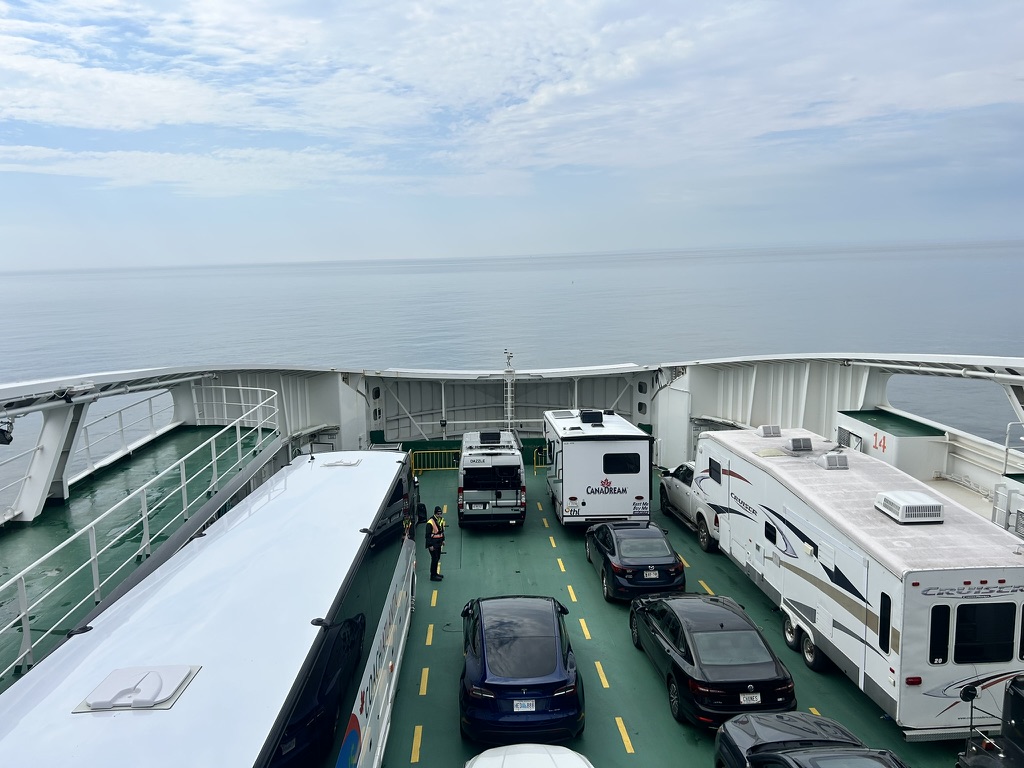
(Where did I park on the ferry)
Standing on the deck, a man called out to me and asked if I had studied at Tufts. His daughter had gone there too. He asked if I was Chinese, and whether I spoke Mandarin. They were Canadian Jews. The son’s name was Jamie, and he had been studying Chinese for fifteen years. Whenever he met Chinese people, he would look for a chance to practice. We had a great conversation on the ferry. Jamie mentioned he had just received an offer from a school in Hangzhou and would be going to China that summer to teach Chinese. He was full of enthusiasm for the country. Earlier in his life, he had taught English in South Korea, at a cram school. He said the work pressure there was overwhelming. What he wanted now was a job at a public school, more holidays, less stress.
In this part of Canada, most travelers follow more or less the same route. By the time I drove to Cape Breton, they were still nearby. We made plans to have dinner together sometime.
To be honest, when I’m traveling alone, I’m especially cautious around men. And it’s not just when I’m traveling. Even in the city where I live, I’m careful. In some ways, I would describe myself as someone who distrusts men, and I’ve generally kept my distance. Professionally, I’ve never had much difficulty. But in my personal life, I used to have many male friends, and over time, for various reasons, I lost touch with all of them. It wasn’t until I moved into my current place — where all my initial roommates were men — that I was forced, passively, to rebuild relationships with the opposite sex. It was only after enough positive experiences accumulated that I slowly began to feel like I could be friends with men again. Given how deep my distrust once ran, the idea of me marrying a man as a heterosexual woman would once have seemed unlikely. And yet here I am, happily married, while still being able to fully understand why so many of my female friends feel the way they do. For women living in China, there is no shortage of things that unsettle them.
Part of why I trusted Jamie and his father, I think, was that they were traveling together. There’s something about a father and son that felt safe. By the time I reached Cape Breton, I’d been on the road for nearly a week. Solo travel had been a joy, but I was also happy for the chance to talk to someone new. Another factor: I was married. I held quietly to the unspoken rule that men don’t press too close to a woman who is already someone’s wife. And so, naturally, my guard came down.
Earlier that day, I had messaged Jamie on WeChat. His profile photo showed him standing between a Chinese flag and a Canadian flag, dressed formally.
I had planned to hike that day. I had plenty of time. But on the way, I came across a motorcyclist who had crashed into a roadside barrier. I stayed with him and used my satellite phone to call an ambulance. By the time that was sorted, I went straight to the restaurant to meet Jamie and his father. The mountain would have to wait.
Jamie and I picked up the conversation where we had left off. He asked if I’d been to any of the Chinese cities he’d visited. We talked about his trip to Taiwan. When he said the word Kahsiung/Gaoxiong, his pronunciation was remarkably precise — not just the confident second tone on siung/xiong, but something in his intonation that traced a kind of spiral: a firm bite, and then a slow, swaying landing. It sounded Taiwanese.
I told him I’d never been to Kaohsiung, only to Tainan, many years ago.
I asked how his job search was going. In theory, he was supposed to start in Hangzhou in mid-August. He told me the offer had been pulled at the last minute, and that he’d have to start applying again. He seemed deflated. His father, on the other hand, was brimming with confidence — his son would find something, he was sure of it.
They told me about a trip they had taken to China together. Once, in Shanghai, a crowd had gathered around Jamie on the street, marveling that a foreigner could speak Chinese so well. His father didn’t speak the language himself, but he was so proud that he’d picked up a few things along the way.
“You know, Chinese is very hard,” the father said. “Tāng 汤— that’s soup you drink. Táng糖 — that’s sugar, the sweet kind. Tǎng 躺— that’s lying down to sleep. Tàng 烫 — that means something is burning hot. And honey is Fēngmì蜂蜜, but a honey bee is Mìfēng蜜蜂. This language is so difficult, and my son has learned it beautifully.”
On the back of my phone case, there was a line from a Yuan dynasty song. I asked Jamie if he could read it.
山中何事,松花酿酒,春水煎茶。
What is there to do in the mountains? Brew wine from pine pollen, boil spring water for tea.
Jamie couldn’t make out the characters. For those of us who grew up reading Chinese, literacy feels like the most basic thing. But for many people who learn Chinese as a foreign language, reading is genuinely one of the hardest parts. You can speak fluently and still not recognize many written characters.
Perhaps a little embarrassed, Jamie quickly turned the tables and asked if I knew the birthdays and death dates of Mao Zedong and Chiang Kai-shek. I said I didn’t. He proceeded to recite a string of historical trivia.
I could see he felt awkward, so I said: your Chinese is more than good enough. Living in China won’t be a problem at all.
We talked about Canada. If anything, I probably know Canadian geography better than Chinese geography at this point. I was crossing Canada many times alone; he was about to go to China alone. We were the same kind of people, I thought — the kind who leave home to go far away places and listen to other people’s stories.
We said our good wishes, and then we said goodbye.
02
That night I was farther north than the night before, and correspondingly colder. I had booked a campsite near the bathroom in advance. What I hadn’t anticipated was that, since it wasn’t peak season yet, many of the campground bathrooms were still closed. I ended up shivering my way to a distant facility that happened to be open. There was no cell signal that night, so I used my satellite phone to send Kevin a message letting him know I was safe.
I slept terribly. Before the trip, I had been so pleased with myself for building a fold-flat bed that fit inside the car. I’d laid out my favorite camping mattress on top and felt very satisfied with the whole arrangement. What I hadn’t considered was that memory foam, in cold weather, freezes solid. Lying on my back, I felt too much warmth escaping from the top of my sleeping bag. On my side, my shoulders and arms had to work just to hold me up against the rigid surface. After several attempts, I settled on lying flat and placing my stuffed porcupine — a small plush toy I always travel with on my collarbone, to block some of the gap at the top of the sleeping bag. The porcupine was soft, but it was cold. I missed a living thing, desperately. Something soft, warm and alive.
I woke at one in the morning to a strange humming sound coming from the car. I was frightened. I was heading into more remote territory. And I could not afford for anything to go wrong. I climbed out of the mattress and started the engine. When I turned it off again, the sound was gone. I crawled back into my sleeping bag. I felt afraid. I felt cold. I felt lonely.
Maybe I had forgotten what loneliness used to feel like. But in that moment, I couldn’t think of a single time I had been more alone. I missed Kevin. I tried to picture our cat, Violet, curled up comfortably somewhere on the bed at home.
I rested a hand on my stomach. I felt the tears coming before they arrived, and then they did. I talked to myself the way Kevin talks to me. I told myself I was a brave little rabbit, good at solving every problem.
Brave little rabbit. Brave little rabbit.
I coaxed myself to sleep. When I left the campsite in the morning, there was a snowshoe hare at the edge of the road, bounding along.
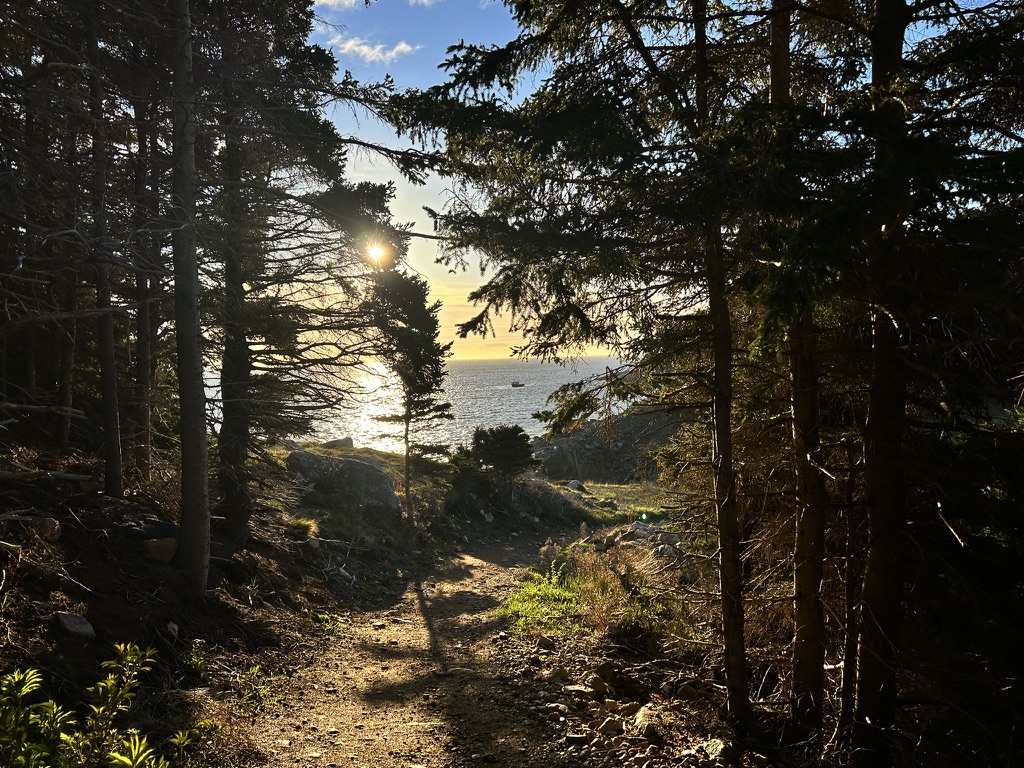
I woke up around five the next day. And that left time to hike the mountain I hadn’t made it to the day before. The trail was empty. To keep the bears away, I talked loudly to myself as I walked. I noticed, after a while, that I sounded exactly like my mother when she’s making conversation for the sake of it. Something about that made me feel more forgiving of her. Talking to myself like this, I even discovered I had a certain flair for stand-up comedy. When I ran out of things to say, I started singing. But I don’t actually know that many songs. Sometimes I shouted. Sometimes I tried to imitate the birds. No bears appeared, though I did come across some coyote droppings. There must have been one nearby.
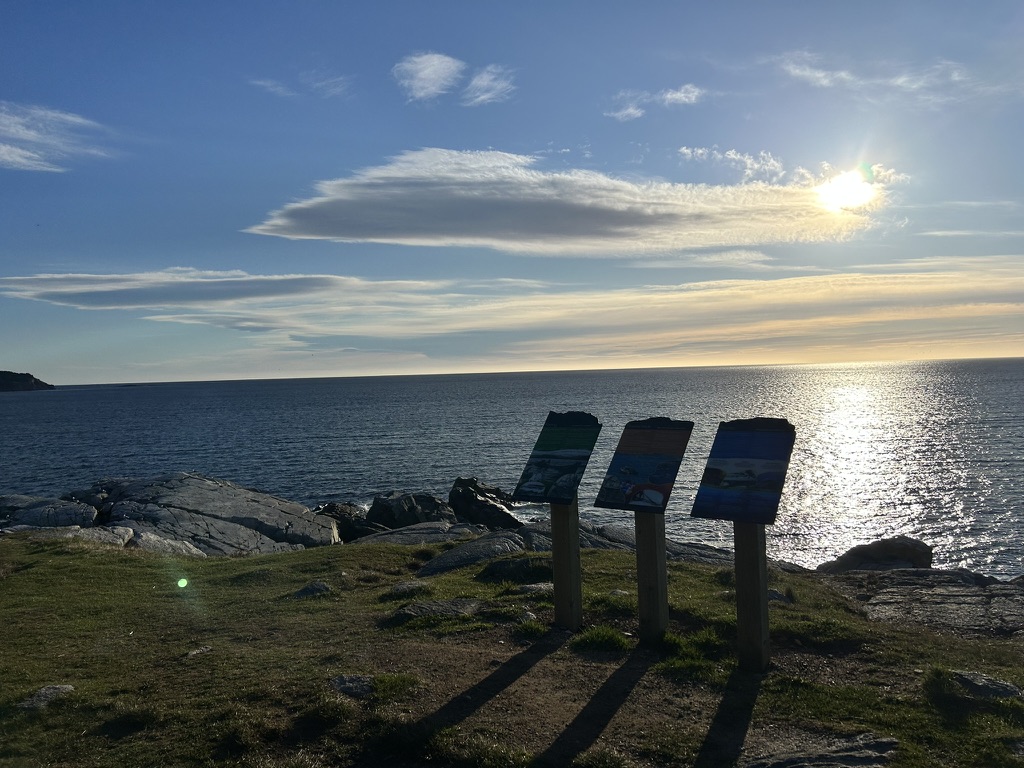
The trail was beautiful. The sea was with me the whole way, shimmering at my side. By the time I reached the top, it was around seven in the morning. Fishing boats were already out on the water, pushing softly through the waves, with gulls circling around them.
At the end of the trail, three signs stood together, each written in a different language. There was a kind of loneliness there — remote and quiet, almost sacred.
When the sun came up, the fear inside me melted away like snow in early spring, and I got back on the road.
 Ingrid ZH | Fangruo’s Cereal — Writing, Food, Travel & Coaching
Leave a comment